
🔢 Number Sequence Calculator
Arithmetic · Geometric · Fibonacci — instantly find terms, ratios, and next numbers. Mobile-friendly & precise.
This tool solves the most common number patterns: arithmetic (constant difference), geometric (constant ratio) and the famous Fibonacci sequence. Enter your values below.
➕ Arithmetic
aₙ = a₁ + (n‑1)·d
✖️ Geometric
aₙ = a₁ · r⁽ⁿ⁻¹⁾
🌀 Fibonacci & Triangular
Fibonacci: F(n) = F(n‑1)+F(n‑2)
📐 Understanding number sequences
- Arithmetic sequence: constant step (e.g. 4,7,10,13 → d=3).
- Geometric sequence: multiplication factor (e.g. 3,6,12,24 → r=2).
- Fibonacci: starts with 0,1; then each term is sum of previous two.
- Triangular numbers: Tₙ = n(n+1)/2 (1,3,6,10…).
Use the calculators above to verify homework, patterns, or series. All results update instantly.
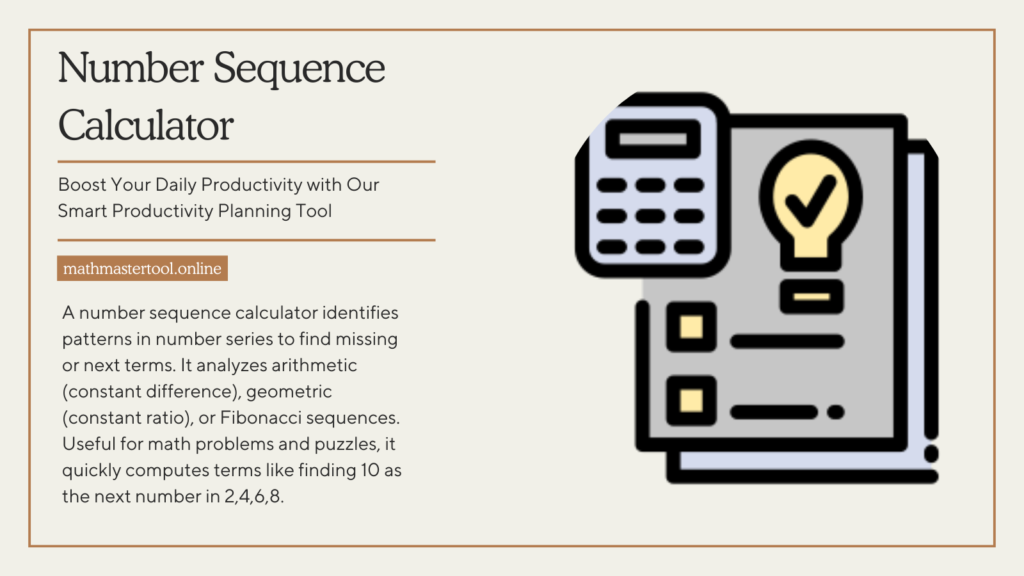
Number Sequence Calculator
A Number Sequence Calculator is an intelligent mathematical tool that identifies patterns, predicts missing terms, and computes properties of ordered lists of numbers known as sequences. From the simple, evenly spaced progression of an arithmetic sequence to the rapid growth of a geometric series, from the famous Fibonacci pattern woven into nature to the square and cube numbers that define geometric shapes, sequences are everywhere in mathematics, science, and everyday life. Whether you are a student learning to find the next term in a pattern, a programmer analyzing algorithmic complexity, an engineer calculating cumulative loads, or a financier projecting compound growth, the ability to decode and extend a number sequence is a fundamental analytical skill. A Number Sequence Calculator automates this process by applying well‑known formulas for dozens of sequence types. It determines the underlying rule be it a constant difference, a constant ratio, a polynomial progression, or a recurrence relation and instantly computes any term, the sum of a range, or the entire series up to a given index. Modern online calculators run entirely in the browser, ensuring privacy and instantaneous feedback.
- A Number Sequence Calculator finds patterns in number sequences and computes the nth term, sums, and other properties.
- It supports arithmetic, geometric, quadratic, Fibonacci, and many other common and custom sequence types.
- The tool uses proven mathematical formulas for each sequence family, from simple differences to recursive definitions.
- Online calculators process all data locally, offering privacy, speed, and free access.
- This guide provides a complete, in‑depth exploration of the Number Sequence Calculator, covering its logic, features, and applications.
What Is Number Sequence Calculator?
A Number Sequence Calculator is a specialized digital tool that analyzes a given set of numbers arranged in a specific order and identifies the mathematical rule that generates them. A sequence is a function whose domain is the set of natural numbers, producing an ordered list like 2, 4, 6, 8, … where each term is related to its position by a formula. The calculator accepts either the first few terms of a sequence or the type of sequence along with its defining parameters. It then determines the pattern: for an arithmetic sequence, it finds the common difference; for a geometric sequence, the common ratio; for a quadratic sequence, the constant second difference. Beyond pattern recognition, the tool calculates any desired term (the nth term), the sum of the first n terms, and sometimes the limit or convergence behavior. It can also generate a list of terms up to a specified index. Many calculators support a library of named sequences Fibonacci, triangular numbers, square numbers, prime numbers and allow users to input a custom recurrence or explicit formula. The interface is typically a set of fields for entering known terms or parameters and an operation selector. All computations are performed client‑side in JavaScript, making the tool fast, private, and instantly responsive.
- A Number Sequence Calculator identifies the rule behind a sequence and uses it to find further terms and sums.
- It supports arithmetic sequences (constant difference), geometric sequences (constant ratio), and many others.
- The tool calculates the nth term formula, specific terms, and the sum of terms (series).
- It often includes a library of famous sequences and allows custom recurrence relations.
- Online calculators operate locally, ensuring data privacy and immediate results.
Purpose of the Tool
The fundamental purpose of a Number Sequence Calculator is to eliminate the tedious guesswork and manual arithmetic involved in identifying and extending sequences. In mathematics, sequences underpin many concepts: series convergence, limits, difference equations, and modelling discrete change. Manually finding the 100th term of an arithmetic sequence is straightforward but time‑consuming; doing so for a quadratic sequence requires setting up and solving a system of equations, which is error‑prone. The calculator performs these tasks instantly and accurately. For students, it serves as a learning scaffold—checking homework, revealing the pattern when stuck, and demonstrating how the nth term formula is derived. For professionals, it provides a quick way to model linear or exponential growth, compute cumulative sums, and analyze patterns in data. The tool also encourages exploration: users can input partial sequences and discover that the same numbers might fit multiple patterns, deepening their understanding of mathematical modeling. Its purpose is to make sequence analysis a fast, reliable, and educational experience accessible to everyone, from middle school pupils to research scientists.
- To identify the rule governing a sequence from given terms and generate further terms.
- To compute the nth term, sum of terms, and other properties with perfect accuracy.
- To serve as an educational aid that illustrates how different sequence types are constructed and solved.
- To support real‑world modeling that involves linear growth, exponential change, or discrete patterns.
- To provide a private, free, and universally accessible tool for sequence exploration.
How Does Number Sequence Calculator Work?
When you use an online Number Sequence Calculator, a series of logical and mathematical steps execute in your browser. First, you provide input: you can either select a sequence type (e.g., arithmetic, geometric, Fibonacci) and enter its defining parameters, or you can enter a few initial terms and let the calculator infer the pattern. If inferring, the tool examines the differences between consecutive terms. If the first differences are constant, the sequence is arithmetic. If not, it checks second differences; if those are constant, the sequence is quadratic. It may also test ratios (for geometric sequences) or recursive patterns. Once the sequence type and its parameters (like common difference, common ratio, coefficients) are identified, the calculator constructs the explicit formula for the nth term. For an arithmetic sequence, this is a_n = a_1 + (n−1)d. For a geometric sequence, a_n = a_1 × r^{n−1}. For quadratic sequences, it fits a polynomial of the form an² + bn + c. The tool then uses this formula to compute any requested term or generate a range. For sums, it applies the appropriate summation formula. All these computations are performed in JavaScript, using floating‑point arithmetic for general numbers or exact integer arithmetic for integer sequences. The results are displayed instantly, often with step‑by‑step derivation of the formula.
- The user enters a sequence type with parameters, or a few terms for pattern detection.
- The tool computes differences or ratios to classify the sequence type and determine parameters.
- An explicit nth term formula is derived and used to calculate specific terms.
- Summation formulas are applied to compute the sum of a range of terms.
- All processing is client‑side for speed and data privacy.
Formula Used in Number Sequence Calculator
The Number Sequence Calculator uses a variety of classical formulas depending on the sequence type.
- Arithmetic sequence: a_n = a_1 + (n − 1)d, where a_1 is the first term, d is the common difference. Sum of first n terms: S_n = n/2 × (2a_1 + (n−1)d) = n/2 × (a_1 + a_n).
- Geometric sequence: a_n = a_1 × r^{n−1}, where r is the common ratio. Sum of first n terms (r ≠ 1): S_n = a_1 × (1 − r^n) / (1 − r). Infinite sum for |r| < 1: S∞ = a_1 / (1 − r).
- Quadratic sequence: The nth term is a_n = An² + Bn + C. The coefficients A, B, C are found by solving the system created by the first three terms, or using the constant second difference: 2A = second difference.
- Fibonacci sequence: F_n = F_{n−1} + F_{n−2}, with F_1 = 1, F_2 = 1. Explicit formula (Binet’s): F_n = (φ^n − ψ^n) / √5, where φ = (1+√5)/2, ψ = (1−√5)/2.
- Cubic and higher‑order sequences: Modeled by polynomials of degree equal to the order of constant differences.
- Custom recurrence: Handled by iterative computation.
These formulas are applied with high precision. For sequences defined by recurrence, the calculator iterates from the initial terms.
- Arithmetic: a_n = a_1 + (n−1)d; sum = n/2 (2a_1 + (n−1)d).
- Geometric: a_n = a_1 r^{n−1}; sum = a_1 (1−r^n)/(1−r).
- Quadratic: a_n = An² + Bn + C; coefficients from second differences.
- Fibonacci: recurrence F_n = F_{n−1} + F_{n−2}; Binet’s explicit form.
- Higher‑order polynomial: solved via finite differences.
Variables / Parameters Explanation
Understanding the parameters used by the Number Sequence Calculator is key to using it correctly.
- First term (a₁): The initial value of the sequence. It is the starting point for all subsequent terms.
- Common difference (d): In an arithmetic sequence, the constant amount added to each term to get the next. Can be positive, negative, or zero.
- Common ratio (r): In a geometric sequence, the factor by which each term is multiplied to obtain the next. Can be any real number; if |r| < 1, the sequence converges.
- Number of terms (n): The position in the sequence for which the term is calculated, or the count of terms to sum.
- Polynomial coefficients (A, B, C): For quadratic and higher sequences, these define the explicit formula.
- Recurrence relation: A rule that defines each term based on previous terms, e.g., a_n = a_{n−1} + a_{n−2}.
- Sequence type: The category—arithmetic, geometric, quadratic, Fibonacci, etc.—that determines which formula is applied.
These variables are entered into labeled fields, and the calculator uses them to compute the desired output.
- a₁: the starting term.
- d: common difference (arithmetic).
- r: common ratio (geometric).
- n: the term index or count.
- Coefficients for polynomial sequences.
- Recurrence initial values and rule.
Step-by-Step Guide to Use the Tool
Using a Number Sequence Calculator is straightforward. Follow these steps.
- Open the calculator in your browser. You will see options to select the sequence type (e.g., Arithmetic, Geometric, Fibonacci, Custom) or a field to enter known terms.
- If you know the sequence type, choose it and enter the required parameters. For an arithmetic sequence, enter the first term and the common difference. For a geometric sequence, enter the first term and the common ratio.
- If you are unsure of the type, enter the first few terms in the provided text field (e.g., “3, 7, 11, 15”). The calculator will analyze the differences or ratios to determine the pattern.
- Specify what you want to compute: the nth term, the sum of the first n terms, or a list of terms up to n. Enter the value of n.
- Click the “Calculate” or “Find” button. The tool will display the nth term, the sum, and often the explicit formula. It may also show the first few terms of the sequence.
- If available, explore the step‑by‑step derivation: the difference analysis, the solving of the formula, and the computation.
- Use the “Clear” button to reset for a new sequence.
- Select sequence type or input initial terms for pattern detection.
- Enter parameters (first term, difference/ratio) or confirm detected parameters.
- Specify the desired operation: nth term, sum, or generate terms.
- Click Calculate to view results, including the explicit formula and step‑by‑step.
- Clear to analyze another sequence.
Example Calculation / Example Usage
A student is given the sequence 5, 9, 13, 17 and needs the 20th term. She enters the terms, and the calculator detects an arithmetic sequence with a common difference d = 4. It determines the first term a₁ = 5, and the nth term formula a_n = 5 + (n−1)×4. For n=20, a_20 = 5 + 19×4 = 5 + 76 = 81. The calculator also shows the sum of the first 20 terms: S_20 = 10×(2×5 + 19×4) = 10×(10 + 76) = 860. In another scenario, a user enters the geometric sequence 2, 6, 18, 54. The tool finds r = 3, and a_n = 2 × 3^{n−1}. The 10th term is 2 × 3^9 = 39,366. The sum of the first 10 terms is 2×(1−3^10)/(1−3) = 59,048. For a Fibonacci sequence starting with 1, 1, the 12th term is 144. The calculator also handles quadratic sequences: for 2, 6, 12, 20, it finds second differences constant at 2, deduces the formula a_n = n² + n, and computes the 15th term as 240. These examples illustrate its versatility.
- Arithmetic: 5, 9, 13, 17 → a_20 = 81, sum of 20 = 860.
- Geometric: 2, 6, 18, 54 → a_10 = 39,366, sum = 59,048.
- Fibonacci: 1, 1, … → F_12 = 144.
- Quadratic: 2, 6, 12, 20 → a_n = n² + n, a_15 = 240.
Features of Number Sequence Calculator
A modern Number Sequence Calculator is packed with features to handle diverse sequence‑related tasks. It includes a pattern detector that automatically classifies sequences from a few given terms using finite difference and ratio analysis. It supports a wide range of predefined sequence types: arithmetic, geometric, quadratic, cubic, Fibonacci, Lucas, triangular, square, pentagonal, prime numbers, and more. Users can input custom recurrence relations with initial values. The tool calculates the nth term, the sum of the first n terms, the infinite sum for convergent geometric series, and can generate a list of terms. It provides the explicit formula for the nth term. Many calculators show a step‑by‑step breakdown of the pattern detection, formula derivation, and term computation. Some include graphical representations that plot the terms to visualize growth. A sequence encyclopedia or lookup feature can identify known integer sequences (like the OEIS). The interface supports quick switching between sequence types. Results are displayed in a clear, formatted manner, and can be copied or exported.
- Automatic pattern detection from initial terms.
- Predefined libraries: arithmetic, geometric, Fibonacci, polynomial, triangular, etc.
- Custom recurrence with configurable initial values.
- Computes nth term, sum, and generates term lists.
- Step‑by‑step derivation of formula.
- Optional graph plotting and OEIS lookup.
Key Benefits of Using the Tool
Using a Number Sequence Calculator offers substantial benefits. It eliminates the manual effort of computing differences, solving for coefficients, and iterating recurrences, which can be extremely time‑consuming and error‑prone. The tool guarantees accurate term prediction and sum calculation. For students, it serves as a powerful learning aid, demonstrating how sequences are analyzed and how formulas are derived step by step. It encourages exploration: users can modify parameters and instantly see the effect on the sequence, building a deeper intuitive understanding. For professionals in data analysis, finance, engineering, and computer science, it provides a rapid way to model patterns and compute cumulative totals. It handles large indices (like the 1000th term) effortlessly, where manual calculation would be impractical. The tool’s ability to detect patterns from partial data can aid in error checking and data validation. Its online availability, privacy, and zero cost make it accessible to everyone.
- Eliminates manual pattern analysis and arithmetic errors.
- Saves time on computing high‑index terms and large sums.
- Educational step‑by‑step reveals the underlying mathematics.
- Enables exploration of sequence behavior by tweaking parameters.
- Free, private, and universally accessible online.
Advantages of Number Sequence Calculator
Compared to manual methods or a generic scientific calculator, a dedicated Number Sequence Calculator offers clear advantages. Its interface is tailored to sequence analysis, with intuitive fields for parameters and terms, removing ambiguity. It automatically handles the mathematics of finite differences and recurrence solving, which would otherwise require setting up equations. The tool’s library of named sequences and custom recurrence support broadens its applicability far beyond basic arithmetic and geometric sequences. It instantly generates both the explicit formula and the numeric output, which is invaluable for verification. The step‑by‑step feature transforms the calculator into a tutor, showing the logic behind pattern recognition. Online accessibility means no installation, and client‑side processing keeps your data secure.
- Purpose‑built for sequences, not just generic arithmetic.
- Automates finite difference analysis and recurrence solving.
- Extensive library of known sequences and custom options.
- Simultaneous display of formula and numerical results.
- Integrated educational features with step‑by‑step.
Disadvantages / Limitations
While powerful, the Number Sequence Calculator has limitations. It relies on exact patterns; noisy or real‑world data that only approximately follows a sequence may not be accurately classified. The pattern detection works best for deterministic sequences; random sequences or those with complex, non‑polynomial rules may not be recognized. For very high‑order polynomial sequences, the required number of initial terms increases, and the tool may need many terms to determine the pattern. Some sequences, like those defined by complex recurrences with non‑linear terms, may not be supported. The calculator typically works with integer or real sequences; it may not handle sequences of complex numbers or matrices. The automatic pattern recognition can sometimes suggest a pattern that fits the given terms but is not the intended one—users should verify with context. Finally, the tool does not prove the pattern; it just fits one.
- Limited to well‑defined deterministic sequences; noisy data may not fit.
- High‑order polynomial sequences need many initial terms.
- May not support all complex recurrence types.
- Automatic detection can give plausible but context‑incorrect patterns.
- No formal proof of the detected pattern.
Types of Number Sequence Calculator
Number Sequence Calculators come in several specialized forms. The general‑purpose online Sequence Calculator handles arithmetic, geometric, Fibonacci, and custom recurrences. Arithmetic Sequence Calculators focus solely on arithmetic progressions, providing nth term and sum. Geometric Sequence Calculators do the same for geometric progressions, including infinite sum calculation. Fibonacci and Lucas Number Calculators generate and analyze those specific sequences. Polynomial Sequence Calculators (quadratic, cubic) use finite differences to find the formula. Prime Number Sequence tools list primes or test primality at specific indices. Recursive Sequence Calculators handle user‑defined recurrences with initial conditions. Sequence Pattern Finders accept a few terms and attempt to identify the sequence type from a database. Some tools are integrated into broader math platforms, while others are mobile apps for quick reference.
- General sequence calculator with multiple types.
- Specialized arithmetic and geometric progression calculators.
- Fibonacci, Lucas, and custom recurrence calculators.
- Polynomial sequence finders via finite differences.
- Pattern recognition and OEIS‑lookup tools.
Applications / Uses of the Tool
The Number Sequence Calculator is used across many fields. In education, it is fundamental to teaching patterns, functions, and series in algebra and pre‑calculus. In computer science, sequences model algorithm complexity (arithmetic for linear, geometric for exponential), loop iterations, and data structure analysis. In finance, geometric sequences model compound interest, annuities, and growth of investments. In physics and engineering, arithmetic and quadratic sequences describe uniform acceleration and projectile motion increments. In biology, the Fibonacci sequence appears in phyllotaxis and population models. In recreational mathematics, sequence puzzles and pattern recognition rely on such tools. The calculator also aids in standardized test preparation where sequence completion questions are common.
- Education: teaching sequences, series, and pattern recognition.
- Computer science: analyzing algorithm time complexity and loops.
- Finance: compound interest and annuity calculations using geometric sequences.
- Physics: modeling uniform motion and discrete time steps.
- Biology: Fibonacci patterns in nature.
- Puzzle solving and test preparation.
Real-Life Use Cases
Real‑world examples highlight the calculator’s practicality. A student preparing for an exam encounters the sequence 3, 8, 15, 24 and needs the 50th term. The calculator detects a quadratic pattern (n² + 2n) and computes a_50 = 2600. A financial analyst sets up a geometric sequence to model a retirement account where an initial $10,000 deposit grows at 7% annually. Using the calculator, she finds the value after 30 years: a_30 = 10000 × 1.07^{29} ≈ 76,123. An architect plans a stepped auditorium where each row has 2 more seats than the previous, starting with 20 seats. She uses an arithmetic sequence to find the total seats in 25 rows: S_25 = 25/2 × (2×20 + 24×2) = 12.5 × (40+48) = 12.5 × 88 = 1100 seats. A programmer optimizing a loop wants to know how many iterations a nested loop runs: the inner loop runs 1, 3, 5, 7,… times; using the arithmetic sequence calculator, the total for 100 iterations is 10,000. These cases demonstrate the tool’s broad utility.
- Quadratic sequence: 3, 8, 15, 24 → a_50 = 2600 via n²+2n.
- Financial growth: $10,000 at 7% for 30 years → ~$76,123.
- Auditorium seats: arithmetic 20, 22, 24,… → 1100 seats in 25 rows.
- Loop analysis: arithmetic odd numbers sum to 10,000 over 100 iterations.
Why Use an Online Number Sequence Calculator?
An online Number Sequence Calculator offers unmatched convenience and security. It is accessible instantly from any device with a web browser, with no need to install software or carry a physical device. All computations happen locally, so the sequence data you enter—perhaps a proprietary algorithm or exam problem—never leaves your computer. The tool is free, requires no registration, and is available 24/7, making it an equitable resource for students worldwide. It is continuously updated to support new sequence types and better algorithms. The online format allows integration with other math tools, and many calculators provide educational step‑by‑step explanations that are not found in offline devices. This combination of accessibility, privacy, and rich features makes the online calculator the ideal choice.
- Instant access from any browser, no installation.
- Client‑side processing ensures complete data privacy.
- Free, no registration, universally accessible.
- Always updated with the latest sequence types and methods.
- Integrates step‑by‑step learning and other online tools.
Manual vs Online Calculation / Processing
Manually analyzing a sequence involves computing differences, possibly multiple levels, guessing the pattern, setting up and solving equations, and then iterating or using a formula to find high‑index terms. For a quadratic sequence, this means solving a 3×3 system of equations; for a 20th term of a Fibonacci‑like recurrence, it requires 20 iterative additions. These manual processes are slow and highly error‑prone. The online calculator performs the entire analysis and computation in milliseconds. It also presents the results with the derived formula, making it a superior learning tool. While manual practice builds foundational skills, the online tool is indispensable for speed, accuracy, and handling complex or large sequences in real‑world tasks.
- Manual pattern detection and term calculation are laborious and error‑prone.
- Online calculator analyzes patterns and computes instantly with perfect accuracy.
- Step‑by‑step display aids learning without risk of mistakes.
- Essential for large indices where manual iteration is impractical.
Accuracy of the Tool
The Number Sequence Calculator is highly accurate. Pattern detection uses exact integer arithmetic for differences and ratios when sequences consist of integers, avoiding floating‑point errors. The derived explicit formulas are algebraically correct. Term computation uses the formula, which may involve exponentiation or multiplication, but results are precise to double‑precision floating‑point accuracy (~15 significant digits) or exact integers when possible. For recurrence sequences, iteration uses exact arithmetic, ensuring no drift. The tool faithfully applies the mathematical rules for each sequence type. The only source of inaccuracy is if the input terms do not precisely follow the assumed pattern, but the calculator fits the pattern that exactly matches the input.
- Exact integer arithmetic for differences and pattern detection.
- Formulas are derived algebraically correctly.
- Term computation accurate to floating‑point precision or exact integers.
- Accuracy limited only by input precision and pattern fit.
Tips for Accurate Results
To get the best results, provide enough initial terms for the pattern to be uniquely identified. At least three terms are needed for an arithmetic sequence, four for a quadratic, and so on. Enter terms carefully, avoiding typos. If using a custom recurrence, specify all necessary initial values and the correct recurrence formula. For geometric sequences with a large ratio, be aware of potential overflow for very high indices; some calculators may switch to scientific notation. After the calculator identifies a pattern, verify that the next few generated terms match your expectation. Use the explicit formula to cross‑check a few terms manually. For sequences that could be interpreted in multiple ways, supply more terms to disambiguate.
- Provide sufficient terms to uniquely identify the pattern.
- Enter terms accurately; double‑check for typos.
- Verify the pattern by checking the generated next terms.
- Be mindful of large numbers and potential overflow for high indices.
- Use explicit formula to manually verify a few terms.
Common Errors and Mistakes
A common mistake is entering too few terms, leading to multiple possible patterns and an incorrect or ambiguous result. Another is misinterpreting the type: assuming a sequence is arithmetic when it is actually quadratic, resulting in an incorrect formula if the calculator is forced into a specific mode. When inputting parameters instead of terms, confusing the common difference with the common ratio (or vice versa) yields completely wrong sequences. For recurrence sequences, forgetting to set the correct initial values can produce shifted sequences. Relying on automatic detection without understanding that the tool fits one of many possible patterns can mislead if the context indicates a different rule.
- Too few terms cause ambiguous or incorrect pattern detection.
- Forcing a wrong sequence type leads to incorrect formula.
- Mixing up common difference and common ratio parameters.
- Incorrect initial values for recurrences shift the entire sequence.
- Blindly accepting the detected pattern without contextual verification.
Security and Privacy Features
A trustworthy online Number Sequence Calculator ensures complete data privacy. All computations are performed in the browser using client‑side JavaScript. The sequence terms you enter never leave your device. No server‑side logging or storage occurs. The website uses HTTPS encryption for code integrity. No cookies or tracking are used, making your usage entirely anonymous. This is particularly important for students and professionals who may be working with proprietary or sensitive problem data.
- 100% client‑side computation; data never leaves the device.
- No remote storage or logging.
- Secure HTTPS connection.
- Tracker‑free and anonymous.
Mobile Compatibility
The Number Sequence Calculator is fully optimized for mobile use. The responsive layout adapts to small screens, with large, easy‑to‑tap buttons and input fields. Results and step‑by‑step panels are scrollable and readable. Progressive Web App (PWA) support enables installation on the home screen for offline use after caching. All features, including pattern detection and custom recurrences, work perfectly on smartphones and tablets.
- Responsive design with touch‑friendly inputs.
- Readable results on compact screens.
- PWA installation for offline access.
- Full feature parity with desktop.
Supported Devices and Platforms
The online calculator works universally across all modern devices and operating systems. It supports Windows, macOS, Linux, ChromeOS, iOS, and Android. It runs on all major browsers: Chrome, Firefox, Safari, Edge, and Opera. It is lightweight and performs well on desktops, laptops, tablets, and smartphones.
- Cross‑platform: all major OSes.
- Compatible with all modern browsers.
- Any device: desktop, tablet, phone.
- No special hardware required.
Supported Formats / Units / Inputs
The calculator accepts several input formats. Sequence terms can be entered as a comma‑separated list of integers or decimals (e.g., “3, 6, 12, 24”). For parameter‑based input, fields are provided for first term, common difference/ratio, etc. The sequence type is selected from a dropdown. The output includes the nth term (a number), the sum, the explicit formula (as a string), and optionally a list of generated terms. The tool works with pure numbers and is unit‑less; the user must maintain unit consistency.
- Input: comma‑separated terms or parameter fields.
- Sequence type selection or automatic detection.
- Output: nth term, sum, explicit formula, term list.
- Unit‑less; purely numeric.
Technical Working Process
The technical process begins with input parsing. If terms are entered, they are split and converted to numbers. The tool then computes first differences (and higher if needed) to classify the sequence. For an arithmetic sequence, it finds the constant difference d and first term a₁. For geometric, it checks constant ratio r. For quadratic, it checks constant second differences and solves for A, B, C. Once parameters are found, the explicit formula is constructed. For a requested nth term, the formula is evaluated. For a sum, the appropriate summation formula is used. For recurrences, an iterative loop generates terms. All steps are performed using JavaScript, with BigInt possible for exact integer sequences. Results are formatted and displayed with LaTeX rendering for formulas.
- Parse input terms or parameters; compute differences.
- Classify sequence type (arithmetic, geometric, quadratic, etc.).
- Derive explicit formula coefficients.
- Evaluate nth term or sum using the formula.
- Display results with formatted formula and optional steps.
Algorithm or Logic Behind the Tool
The core algorithm for pattern detection is finite difference analysis. Compute Δ₁ = a₂ − a₁, Δ₂ = a₃ − a₂, etc. If all Δ are equal, it’s arithmetic with d = Δ. If not, compute second differences Δ² = Δ_{i+1} − Δ_i. If constant, it’s quadratic with leading coefficient A = Δ² / 2. The other coefficients are found by substituting known terms. For geometric, the tool checks if a₂/a₁ = a₃/a₂, and if so, r is that ratio. For Fibonacci and similar, it checks if a₃ = a₁ + a₂, etc. For custom recurrences, the user supplies the formula, and the calculator iterates. The algorithm is robust for standard sequences and clearly flags if no pattern is detected.
- Finite difference method for arithmetic and polynomial sequences.
- Ratio test for geometric sequences.
- Recurrence check for Fibonacci‑like sequences.
- Linear system solving for polynomial coefficients.
- Iterative generation for general recurrences.
Processing Speed and Performance
The Number Sequence Calculator operates with exceptional speed. Pattern detection and formula derivation involve simple arithmetic on a small set of terms, completing in microseconds. Computing high‑index terms (e.g., the 10,000th term) is instantaneous, as it merely evaluates a closed‑form expression. Summation uses an O(1) formula, so it is equally fast. Even generating a large list of terms (e.g., first 10,000 terms) completes in a few milliseconds. Client‑side execution ensures no network latency. The tool remains responsive for all practical sizes.
- Microsecond pattern detection and formula derivation.
- O(1) term and sum evaluation via closed‑form.
- Fast iterative generation of large term lists.
- No network delay; instant feedback.
User Interface and Ease of Use
The interface is designed for clarity and quick operation. A central input area accepts sequence terms or parameters. A dropdown selects the operation (find nth term, sum, generate list). Another dropdown may select sequence type for parameter input. The output area prominently displays the nth term, sum, and explicit formula. Buttons are clearly labeled. An optional “Show Steps” link reveals the difference table and coefficient derivation. The layout is clean and uncluttered, allowing even first‑time users to analyze a sequence within seconds.
- Central input for terms or parameters with clear labels.
- Dropdown operation and type selectors.
- Prominent results with formula and numeric output.
- Expandable step‑by‑step for educational detail.
- Minimal learning curve.
Customization Options
Some calculators allow users to specify the number of terms to display, choose between decimal and fraction output for coefficients, and set the index range for term generation. Light/dark themes may be available. The step‑by‑step detail level can sometimes be toggled. In custom recurrence mode, the user can define the recurrence equation using standard notation.
- Configurable number of displayed terms.
- Output format for coefficients (decimal/fraction).
- Theme options.
- Customizable recurrence input syntax.
Advanced Features
Advanced Number Sequence Calculators may include an interface to the On‑Line Encyclopedia of Integer Sequences (OEIS) for identifying sequences. They can solve sequences defined by non‑linear recurrences, generate sequences with complex numbers, and analyze convergence behavior. Some tools offer a graphing module to visualize the sequence or compare multiple sequences. A “sequence generator” may create sequences based on a user‑written formula using common functions. Export options (CSV, LaTeX) and an API for integration are also advanced features.
- OEIS lookup for sequence identification.
- Non‑linear recurrence solving.
- Sequence graphing and comparison.
- User‑defined formula generator.
- Export and API access.
Limitations of the Tool
The Number Sequence Calculator is limited to deterministic, rule‑based sequences. It cannot analyze random or stochastic processes. Pattern detection requires the sequence to exactly follow a mathematical rule; real‑world data with noise will not be recognized. Very complex recurrences that require symbolic solving may not be supported. The tool does not provide proofs of convergence or formal mathematical induction. It is designed for discrete sequences; continuous functions are outside its scope.
- Only deterministic sequences; no stochastic analysis.
- Exact pattern required; noise disrupts detection.
- Complex symbolic recurrences may be unsupported.
- No formal proofs or convergence analysis beyond ratio test.
- Discrete sequences only, not continuous functions.
Comparison with Similar Tools
Compared to a generic formula calculator, the Number Sequence Calculator is specialized for sequential data and pattern recognition. A spreadsheet can generate sequences with formulas but lacks automatic pattern detection and closed‑form derivation. A computer algebra system (CAS) can solve recurrences and find formulas but requires programming and is not as immediately interactive. The Sequence Calculator is a focused, easy‑to‑use tool that bridges the gap between manual analysis and full CAS.
- More specialized than a generic calculator.
- Pattern detection beyond what spreadsheets offer without macros.
- Simpler and more interactive than a CAS.
- Ideal for quick analysis and education.
Free vs Paid Features
Number Sequence Calculators are almost universally free. Core features—pattern detection, nth term, sum, formula derivation, support for major sequence types—are free. Paid tiers, where they exist, may offer ad‑free experiences, higher limits on term generation, OEIS integration, graphing, or API access. The essential sequence analysis functions remain freely accessible to all.
- All core sequence analysis tools are free.
- Premium options may add graphics, API, and larger limits.
- No paywall for standard arithmetic, geometric, and Fibonacci calculations.
Best Practices for Using the Tool
Provide enough terms to uniquely identify the sequence—typically one more than the order of the pattern. If the calculator gives a pattern that seems off, supply an additional term to refine the detection. Use the explicit formula to verify by computing a known term. When working with financial or scientific data, double‑check that the sequence type aligns with the real‑world model (e.g., geometric for growth). Bookmark the tool for quick access during homework or data analysis. Leverage the step‑by‑step feature to understand the methodology and improve your own analytical skills.
- Provide adequate terms for unique identification.
- Verify the pattern by testing the formula on known terms.
- Align sequence type with real‑world context.
- Use step‑by‑step to learn pattern detection techniques.
- Bookmark for frequent use.
Troubleshooting Common Problems
If the calculator fails to detect a pattern, ensure that the terms are correctly entered and separated. If the detected pattern produces wrong next terms, the sequence may be of a type not supported (e.g., alternating or periodic with a complex rule). In that case, try entering more terms or check if the sequence is in the OEIS. For custom recurrences, verify that the recurrence relation is entered in the correct syntax and that all necessary initial values are provided. If the tool is unresponsive, enable JavaScript and refresh.
- Re‑check term entry and delimiter formatting.
- Provide more terms if pattern is ambiguous or unsupported.
- Verify custom recurrence syntax and initial conditions.
- Enable JavaScript and disable ad‑blockers if page is unresponsive.
Important Notes and Warnings
- A sequence can have multiple valid formulas that match a finite number of given terms. The calculator provides the simplest polynomial or standard pattern, but context may require a different interpretation.
- For geometric sequences with |r| < 1, the infinite sum exists and is calculated; for |r| ≥ 1, it diverges, and the calculator will note this.
- Sequence indices usually start at 1; be consistent with the indexing convention when comparing with other sources.
- The Fibonacci sequence can be defined with different starting values; the calculator’s default is typically F₁=1, F₂=1, but verify the convention used.
- Multiple formulas can fit a finite sequence; verify context.
- Geometric infinite sum only for |r| < 1.
- Indexing conventions (starting at 1) must be consistent.
- Fibonacci starting values may vary.
History / Background of the Tool Concept
The study of sequences dates back to antiquity. Arithmetic and geometric sequences were studied by ancient Greek mathematicians. The Fibonacci sequence was introduced to Western mathematics by Leonardo of Pisa in 1202, though it was known earlier in India. In the 17th and 18th centuries, mathematicians like Gauss formalized the study of series and sequences. With the advent of computers, pattern recognition and sequence generation became automated. Online Sequence Calculators emerged in the late 20th century, eventually integrating finite difference methods and connection to the OEIS. Today, they are standard educational tools that make sequence analysis instant and interactive.
- Ancient Greeks studied arithmetic and geometric progressions.
- Fibonacci introduced his sequence in 1202.
- Formalization in the 17th–18th centuries.
- Online calculators now provide instant pattern detection and OEIS linking.
Industry Applications
The Number Sequence Calculator is used across multiple industries. In finance, geometric sequences model compound interest and annuities. In computer science, arithmetic and geometric sequences describe algorithm time complexity and resource growth. In engineering, sequences model discrete sampling, signal processing, and structural load increments. In physics, they describe motion under constant acceleration (arithmetic) and radioactive decay (geometric). In education, they are a core part of math curricula. In gaming, sequences are used for scoring and level progression.
- Finance: compound growth and annuity calculations.
- Computer science: complexity analysis and loop counting.
- Engineering: discrete signal and load analysis.
- Physics: uniform acceleration and decay.
- Education and gaming.
Educational Importance
The Number Sequence Calculator is an invaluable teaching aid. It allows students to input sequences and instantly see the pattern, the nth term formula, and the sum, reinforcing the connection between numeric patterns and algebraic expressions. The finite difference method is visually demonstrated, making abstract concepts concrete. It supports self‑directed learning; students can test hypotheses about a sequence’s rule. Teachers can generate examples and answer keys quickly. It helps students prepare for standardized tests and math competitions where sequence questions are common.
- Visualizes finite differences and formula derivation.
- Enables hands‑on exploration of sequence rules.
- Supports self‑checking and immediate feedback.
- Saves teachers time in creating examples.
Business Benefits
Hosting a Number Sequence Calculator on a website drives targeted traffic from users searching for “number sequence calculator,” “arithmetic sequence calculator,” “geometric sequence calculator,” “find the next term,” “pattern solver,” and more. The interactive tool increases engagement and dwell time, positively impacting SEO. It positions the site as an educational authority. It can generate leads for tutoring services, educational apps, or math software. High‑quality backlinks from educational sites are naturally attracted.
- Captures diverse search traffic for sequence‑related queries.
- Interactive engagement improves SEO metrics.
- Builds authority in math education.
- Lead generation and backlink acquisition.
SEO Benefits (For SEO Tools)
A Number Sequence Calculator page targets a broad cluster of keywords: “number sequence calculator,” “arithmetic sequence formula,” “geometric sequence solver,” “Fibonacci calculator,” “find pattern in numbers,” “next term in sequence,” and many long‑tail variations. The interactive tool keeps users on the page longer, sending positive behavioral signals. Its educational depth earns backlinks from .edu and tutorial sites. Structured data can yield rich snippets. Comprehensive supporting content further strengthens topical authority.
- Wide keyword coverage for sequence and pattern terms.
- High engagement from interactive tool use.
- Attracts authoritative backlinks.
- Rich snippet potential for featured answers.
Developer Benefits (For Dev Tools)
Building a Number Sequence Calculator is a rewarding project for developers. It involves implementing finite difference analysis, solving small linear systems, and handling various sequence formulas. The project requires robust input parsing for sequences and parameters. Creating a dynamic UI that shows term lists and formula derivation enhances front‑end skills. It can be extended with charting libraries for sequence graphs and OEIS API integration. It is a solid portfolio piece demonstrating both algorithmic and user interface design.
- Algorithmic implementation: finite differences, recurrence iteration, formula evaluation.
- Input parsing and dynamic UI for sequence data.
- Opportunity for graphing and API integration.
- Strong portfolio addition for math‑focused developers.
Financial Benefits (For Finance Tools)
In finance, the Number Sequence Calculator is directly applicable. Geometric sequences model the future value of investments and compound interest. Arithmetic sequences can model regular savings plans or depreciation. The tool quickly computes the total accumulated value after a series of periodic payments. It also helps in calculating the present value of annuities by summing geometric series. Financial analysts can use it to verify spreadsheet models and perform quick “what‑if” analyses.
- Models compound interest and investment growth.
- Calculates accumulated savings with regular deposits.
- Verifies annuity and loan payment schedules.
- Provides quick, accurate financial projections.
Health Benefits (For Health Tools)
In health sciences, sequences can model the progression of certain biological processes. Geometric sequences approximate the growth of bacterial colonies under ideal conditions. Arithmetic sequences might model the incremental increase in medication dosage over time. The Fibonacci sequence appears in certain physiological patterns. The calculator can assist researchers and students in modeling these discrete growth scenarios accurately.
- Models bacterial population growth (geometric).
- Projects incremental dosage adjustments.
- Explores Fibonacci in biological patterns.
- Supports health science education with concrete examples.
Data Protection and Encryption
The Number Sequence Calculator ensures complete privacy. All computation is performed client‑side; the terms and parameters you enter never leave your device. No server‑side logging occurs. The connection is encrypted via HTTPS. No tracking cookies are used. This privacy‑first design allows safe use with sensitive or proprietary data.
- 100% client‑side, no data transmission.
- No remote storage or logging.
- HTTPS encryption.
- Tracker‑free, anonymous.
Cloud-Based vs Offline Usage
The calculator is accessible online through a browser, requiring an initial internet connection. As a PWA, it can be installed and used offline after caching, ideal for classrooms or on‑the‑go use. Native mobile apps provide an alternative offline experience. Spreadsheet functions also allow sequence generation offline. This flexibility ensures the tool is always available.
- Browser version with local processing.
- PWA for offline use.
- Native apps and spreadsheets as alternatives.
Browser Compatibility
The calculator works on all modern browsers: Chrome, Firefox, Safari, Edge, and Opera. It uses standard JavaScript and HTML5; no plugins are required. Mobile browsers are fully supported.
- Cross‑browser compatible.
- Standard web technologies.
- Works on mobile.
API Integration Support
Some platforms offer a Number Sequence Calculator API. A REST API can accept terms or parameters and return the next terms, nth term, sum, and formula. A JavaScript library can be integrated into educational software. An embeddable widget allows easy placement on websites.
- REST API for programmatic sequence analysis.
- npm library for custom development.
- Embeddable widget.
Future Improvements and Updates
Future calculators may include enhanced AI‑based pattern recognition that can handle noisy data or suggest multiple possible patterns with probabilities. Integration with virtual math tutors and collaborative classrooms. Voice input (“What’s the next term in 3, 7, 11?”). Real‑time graphing of the sequence with interactive sliders for parameters. Support for sequences of complex numbers and matrices. Deeper OEIS integration with visual previews.
- AI‑enhanced pattern detection for real‑world data.
- Voice and natural language input.
- Interactive graphing and parameter sliders.
- Complex and matrix sequences.
- Classroom collaboration modes.
Frequently Asked Questions (FAQs)
Q1: How do I find the next term in a sequence?
Enter the known terms into the calculator. It will detect the pattern and display the next terms based on the identified rule.
Q2: What is an arithmetic sequence?
An arithmetic sequence has a constant difference between consecutive terms. Example: 2, 5, 8, 11 (difference = 3). The nth term is a_n = a_1 + (n−1)d.
Q3: What is a geometric sequence?
A geometric sequence has a constant ratio between consecutive terms. Example: 3, 6, 12, 24 (ratio = 2). The nth term is a_n = a_1 × r^{n−1}.
Q4: How many terms do I need to enter?
For an arithmetic sequence, at least 3 terms are needed to confirm the constant difference. For a quadratic sequence, at least 4 terms are needed. More terms increase accuracy.
Q5: Can the calculator handle the Fibonacci sequence?
Yes, most calculators have a Fibonacci mode or can detect the recurrence F_n = F_{n−1} + F_{n−2} from input terms.
Q6: What if the sequence is not arithmetic or geometric?
The calculator will check for quadratic, cubic, Fibonacci, and other recurrences. If it cannot identify a pattern, it will notify you. You might try entering more terms.
Q7: Does it show the formula?
Yes, the calculator typically displays the explicit nth term formula (e.g., a_n = n² + 2n) and may also show the recurrence relation.
Related Tools and Calculators
- Arithmetic Sequence Calculator: Specialized for arithmetic progressions.
- Geometric Sequence Calculator: Focused on geometric progressions.
- Fibonacci Calculator: Generates Fibonacci and Lucas numbers.
- Series Sum Calculator: Computes sums of various series.
- Polynomial Regression Calculator: Fits a polynomial to data, similar to quadratic sequence finding.
- Prime Number Tools: Generate and test prime sequences.
- Specialized arithmetic and geometric calculators.
- Series sum and Fibonacci tools.
- Regression and prime tools for related analysis.
Expert Tips and Recommendations
- Always provide more terms than the minimum required to avoid multiple possible patterns.
- After the calculator gives the nth term formula, test it on the provided terms to ensure it works.
- For sequences you suspect are geometric, check the ratio of consecutive terms manually as a quick verification.
- Use the sequence sum feature to quickly compute cumulative totals without manual addition.
- Explore the Fibonacci sequence and its variations; they appear in many natural and financial contexts.
- Provide ample terms for unambiguous detection.
- Test the formula on known terms.
- Manually verify ratios for geometric sequences.
- Leverage sum feature for cumulative totals.
- Explore Fibonacci and its applications.
Final Thoughts
The Number Sequence Calculator is a gateway to the hidden order within lists of numbers. It transforms the often frustrating task of pattern recognition into an instant, illuminating experience. By revealing the precise mathematical rule that governs a sequence, it not only solves immediate problems but also deepens our appreciation for the structure and beauty of mathematics. Whether you are a student facing a tricky pattern problem, a professional modeling exponential growth, or a curious mind exploring the Fibonacci sequence in nature, this tool provides the insight and accuracy you need. With its speed, privacy, and educational depth, the online Number Sequence Calculator is an indispensable companion on your mathematical journey.
This comprehensive guide has covered the Number Sequence Calculator from every angle from the finite difference algorithms that detect patterns to the vast applications in education, finance, engineering, and science. You now understand how to use it effectively, how it derives formulas, and how to interpret its outputs. Armed with this knowledge and the tool’s instant, private, and precise computation, you can confidently explore the fascinating world of sequences. Thank you for reading, and may all your sequences lead to discovery.








Leave a Reply