
Calculators have come a long way from the basic pocket devices many of us used in school. Today, online calculators are specialized tools that help people make better decisions about money, health, and everyday math. Whether you are estimating a mortgage payment, tracking your daily calorie needs, or calculating the number of days between two dates, there is a calculator designed for the task.

Financial Calculators
- Mortgage Calculator
- Loan Calculator
- Auto Loan Calculator
- Interest Calculator
- Payment Calculator
- Retirement Calculator
- Amortization Calculator
- Investment Calculator
- Inflation Calculator
- Finance Calculator
- Income Tax Calculator
- Compound Interest Calculator
- Salary Calculator
- Interest Rate Calculator
- Sales Tax Calculator


This guide breaks down three of the most popular categories: Financial Calculators, Fitness & Health Calculators, and Math Calculators. For each category, we explain what the calculators do, why they are useful, who benefits from them, and how they fit into real-life situations.
What Are Financial Calculators?
Financial calculators are digital tools that perform money-related calculations. They help individuals, families, and businesses understand loans, investments, savings, taxes, and budgets. Instead of manually working through formulas or building complex spreadsheets, users can enter a few numbers and get clear results in seconds.
These calculators are useful because financial decisions often involve long timeframes, compounding interest, and changing rates. A small error in a formula can lead to a very different outcome. Financial calculators reduce that risk by applying standard financial formulas consistently.
Common Types of Financial Calculators
- Mortgage Calculator: Estimates monthly payments, total interest, and payoff date based on loan amount, interest rate, and term.
- Loan Amortization Calculator: Shows a full payment schedule, including how much goes toward principal and interest each month.
- Auto Loan Calculator: Helps buyers estimate monthly car payments, taxes, and fees.
- Investment Return Calculator: Projects future value of investments based on contributions, rate of return, and time.
- Retirement Savings Calculator: Estimates how much you need to save to reach retirement goals.
- Credit Card Payoff Calculator: Shows how long it will take to pay off balances at different payment amounts.
- Budget Calculator: Helps track income and expenses to plan monthly spending.
- Tax Estimator: Provides a rough estimate of federal or state taxes owed.
- Interest Calculator: Calculates simple or compound interest on savings or loans.
Why Use Financial Calculators?
Financial calculators improve accuracy and save time. They also help users compare scenarios. For example, a homebuyer can compare a 15-year mortgage with a 30-year mortgage to see the difference in monthly payments and total interest. A small business owner can estimate loan payments before applying for financing. By making numbers visible, these tools support better decision-making.
Real-World Examples
- A young couple in Texas uses a mortgage calculator to determine how much house they can afford.
- A freelancer in New York uses a tax estimator to set aside money for quarterly taxes.
- A college student uses a loan payoff calculator to plan repayment after graduation.
What Are Fitness & Health Calculators?
Fitness and health calculators are tools that help people understand their bodies and make informed wellness choices. They use standard formulas to estimate metrics like body mass index, calorie needs, body fat percentage, and pregnancy dates. These calculators are not a substitute for medical advice, but they provide useful starting points for personal health planning.
They are popular because they turn complex health formulas into simple inputs and outputs. Instead of researching equations, users can enter their age, height, weight, and activity level to get personalized estimates.
Common Types of Fitness & Health Calculators
- BMI Calculator: Measures body mass index based on height and weight.
- BMR Calculator: Estimates basal metabolic rate the calories your body needs at rest.
- TDEE Calculator: Calculates total daily energy expenditure based on activity level.
- Calorie Deficit Calculator: Helps determine how many calories to eat for weight loss.
- Macro Calculator: Suggests daily protein, carbohydrate, and fat targets.
- Body Fat Calculator: Estimates body fat percentage using measurements or circumference.
- Pregnancy Due Date Calculator: Estimates a baby’s due date based on last menstrual period.
- Pace Calculator: Helps runners and walkers calculate pace, time, or distance.
- One-Rep Max Calculator: Estimates maximum strength for weightlifting.
- Water Intake Calculator: Suggests daily water needs based on weight and activity.
Why Use Fitness & Health Calculators?
These calculators provide personalized targets, which can be more motivating than generic advice. They also help track progress over time. For example, a person trying to lose weight can use a TDEE calculator to set a calorie goal, then adjust as their weight changes. Athletes can use pace and one-rep max calculators to train more effectively.
Real-World Examples
- A beginner starting a weight-loss journey uses a calorie deficit calculator to set daily intake.
- A marathon runner uses a pace calculator to plan race splits.
- An expecting mother uses a due date calculator to schedule prenatal appointments.
What Are Math Calculators?
Math calculators solve numerical problems across arithmetic, algebra, geometry, statistics, and more. They range from simple four-function calculators to advanced scientific and graphing tools. Online math calculators are especially useful because they are accessible from any device and often show step-by-step solutions.
These tools help students learn, professionals work faster, and everyday users solve practical problems. They reduce the chance of human error and make complex calculations manageable.
Common Types of Math Calculators
- Basic Calculator: Handles addition, subtraction, multiplication, and division.
- Scientific Calculator: Supports trigonometry, logarithms, exponents, and roots.
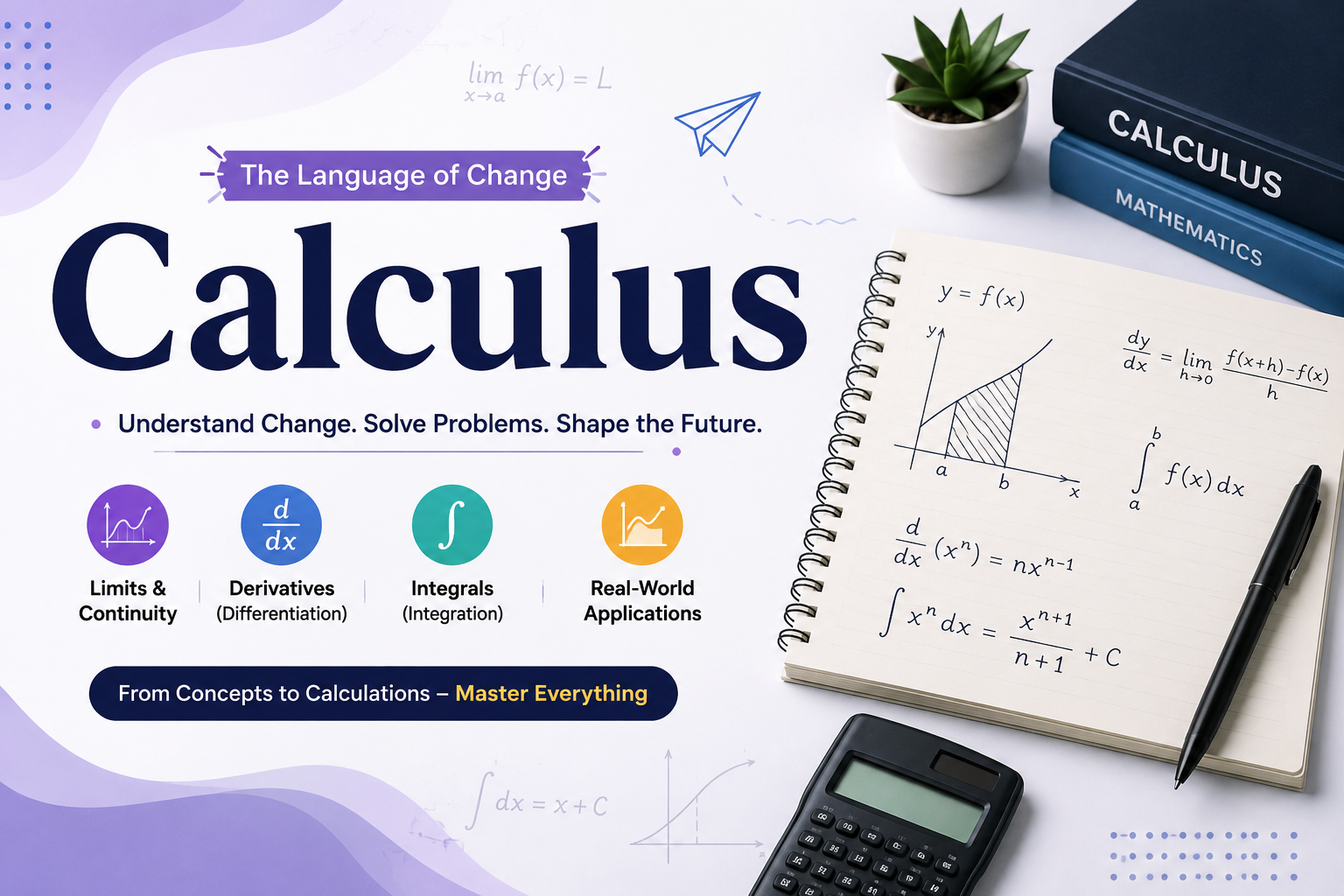
- Graphing Calculator: Plots equations and functions.
- Percentage Calculator: Finds percentages, increases, decreases, and differences.
- Fraction Calculator: Adds, subtracts, multiplies, and divides fractions.
- Date Calculator: Adds or subtracts days, weeks, months, or years and measures the difference between two dates.
- Age Calculator: Determines age in years, months, and days.
- Statistics Calculator: Computes mean, median, mode, standard deviation, and more.
- Geometry Calculator: Solves area, perimeter, volume, and surface area problems.
- Matrix Calculator: Performs matrix operations like multiplication and inversion.
Why Use Math Calculators?
Math calculators save time and improve accuracy. They are particularly helpful for students who want to check their work or learn the steps involved in solving a problem. Professionals in engineering, construction, finance, and science use math calculators to perform quick calculations without writing code or using spreadsheets.
Real-World Examples
- A high school student uses a fraction calculator to check homework answers.
- A contractor uses a geometry calculator to estimate flooring materials.
- An office manager uses a date calculator to determine a project deadline.
The Date Calculator mentioned earlier in this article is a great example of a practical math calculator. It handles two common tasks: adding or subtracting time from a date, and measuring the difference between two dates. It is useful for project planning, legal deadlines, event countdowns, and personal scheduling.
How to Choose the Right Calculator
Choosing the right calculator depends on the task. If you are dealing with money, choose a financial calculator. If you are tracking health or fitness, choose a fitness or health calculator. If you need to solve a numerical problem, choose a math calculator.
Consider these factors:
- Purpose: What exactly are you trying to calculate?
- Accuracy: Does the calculator use standard formulas?
- Ease of Use: Is the interface clear and mobile-friendly?
- Privacy: Does it run in your browser without sending data to a server?
- Output: Does it show results in a way you can use, such as charts, breakdowns, or downloadable files?
Benefits of Using Online Calculators
Online calculators offer several advantages over traditional devices and spreadsheets. They are accessible from any device with a browser, they are often free, and they require no installation. Many are mobile-responsive, so they work well on smartphones and tablets.
They also reduce the need for manual formula writing. This lowers the risk of errors and makes calculations faster. For businesses, embedding calculators into websites can improve customer experience and lead generation. For individuals, they provide quick answers without hassle.
Frequently Asked Questions
Are online calculators accurate?
Most reputable online calculators use standard formulas and are accurate for general purposes. However, they may not account for every edge case, so important decisions should be verified with a professional.
Can I use calculators on my phone?
Yes. Most modern online calculators are mobile-friendly and work in any browser.
Are financial calculators free?
Many are free. Some advanced tools may require a subscription, but basic mortgage, loan, and budget calculators are widely available at no cost.
Do fitness calculators replace medical advice?
No. They provide estimates and general guidance. Always consult a healthcare professional for medical decisions.
What is the best math calculator for students?
It depends on the level. Basic and scientific calculators are good for most schoolwork. Graphing calculators are helpful for advanced algebra and calculus.
Can I use a date calculator for business?
Yes. Date calculators are commonly used for project deadlines, contract periods, invoice due dates, and compliance timelines.
Calculator: Financial, Fitness & Health, and Math Calculators Explained Conclusion
Calculators are more than just number-crunching tools. They help people make informed decisions about money, health, and everyday problems. Financial calculators support budgeting, investing, and loan planning. Fitness and health calculators help users track wellness goals and understand their bodies. Math calculators solve everything from basic arithmetic to complex equations and date math.
Whether you are a professional, a student, or someone simply trying to plan a deadline, there is a calculator for the job. By understanding the different types and their practical applications, you can choose the right tool and get accurate, useful results every








Leave a Reply